The Invisible Battle – Why the Immune System Misses Cancer
Saanvi Lodh
5/5/20262 min read
What is Immunology?
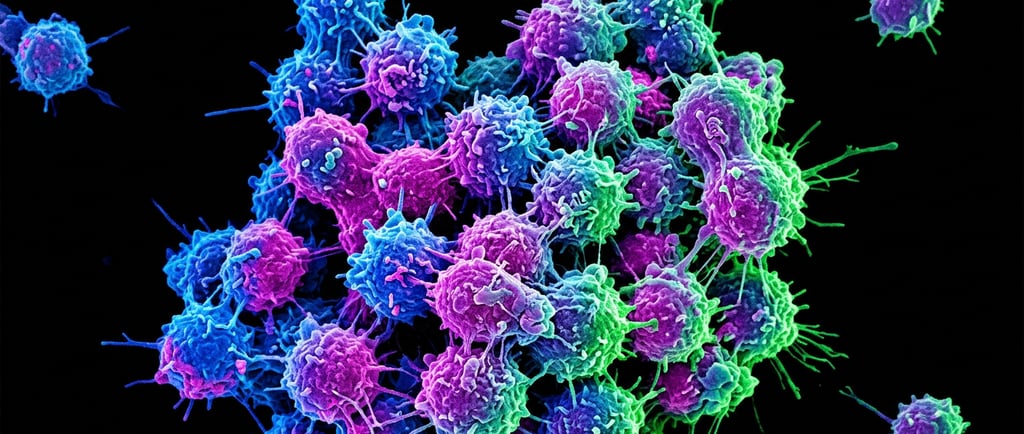
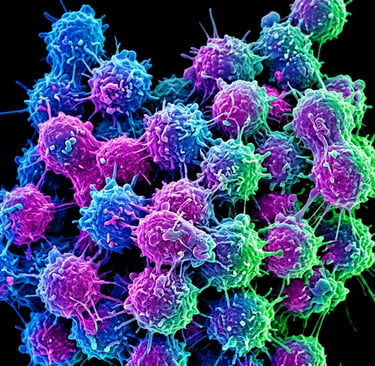
Before we can understand how to fight cancer, we have to understand the "Security Force" of the human body. Immunology is the study of the immune system—a complex network of cells, tissues, and organs that work together to distinguish self (your healthy cells) from non-self (bacteria, viruses, and mutated cells).
At its core, the immune system is a biological recognition engine. It uses protein markers called antigens to identify threats. When a cell is infected or becomes cancerous, it displays strange antigens on its surface. Special white blood cells, primarily T-cells and Natural Killer (NK) cells, act as the elite infantry, patrolling the bloodstream to find and destroy these anomalies.
The Great Deception: Why Cancer is Unique?
Unlike a flu virus, cancer is "self" gone wrong. It is your own cells mutating and growing uncontrollably. This creates a massive problem for the immune system: how do you kill the invader when the invader looks almost exactly like the host?
The "Three Es" of Immunoediting
To understand the life cycle of a tumor, we use a concept called Immunoediting. This explains the transition from health to disease through three distinct phases:
Elimination (The Surveillance Phase):
In this stage, the immune system is winning. As soon as a cell becomes "transformed" (cancerous), the innate and adaptive immune systems work in tandem to kill it. Most cancers in our lives are actually stopped right here, before they ever become a tumor.Equilibrium (The Stalemate):
This is perhaps the most fascinating phase. Here, the immune system wasn't able to fully eliminate the cancer, but the cancer isn't strong enough to grow. The tumor remains in a dormant state. You could have these microscopic camps of cancer cells in your body for decades without ever feeling sick. They are being held at bay by a constant, exhausting biological standoff.Escape (The Breakthrough):
This is where clinical cancer begins. The cancer cells eventually mutate to become invisible.They might stop producing the antigens that T-cells recognize, or they might begin to secrete suppressive signals that physically turn off the immune cells around them. The security guards are still there, but the burglar has put on a uniform and is now walking right past them.
Conclusion
Understanding cancer isn't just about looking at a tumor under a microscope; it’s about understanding a failed conversation. The "Escape" phase is a breakdown in communication.
Contact
Reach out with questions or feedback anytime.
Phone
+91 9073922881
© 2026. All rights reserved.